

Code-switching with: Caterina Detti
In the second interview of a new series, I speak to Paris bookshop owner Caterina Detti about multilingualism in France and how she came to run one of the country’s few Arabic-language bookshops

Welcome to “Code-switching with” a new series of conversations with multilingual creatives on language, identity, and expression. It lands in inboxes (roughly) once a month alongside my regular Beyond Words letter, which compiles linguistic news from around the world. My first interview was with Marseille-based chef Zuri Camille de Souza, and you can read it here.
The name of this series comes from a concept in linguistics: code-switching is the practice of shifting between languages, dialects or speech styles within a single conversation. It’s common in multilingual societies and communities, and many of us do it all the time without even realising it. In my work as a freelance journalist, I regularly meet interesting, creative polyglots, but their thoughts on language rarely make it into whatever it is that I’m writing — even though it often shapes their lives in significant ways, and can offer a fascinating window into their minds. This series is a space for those conversations. I hope you enjoy it.
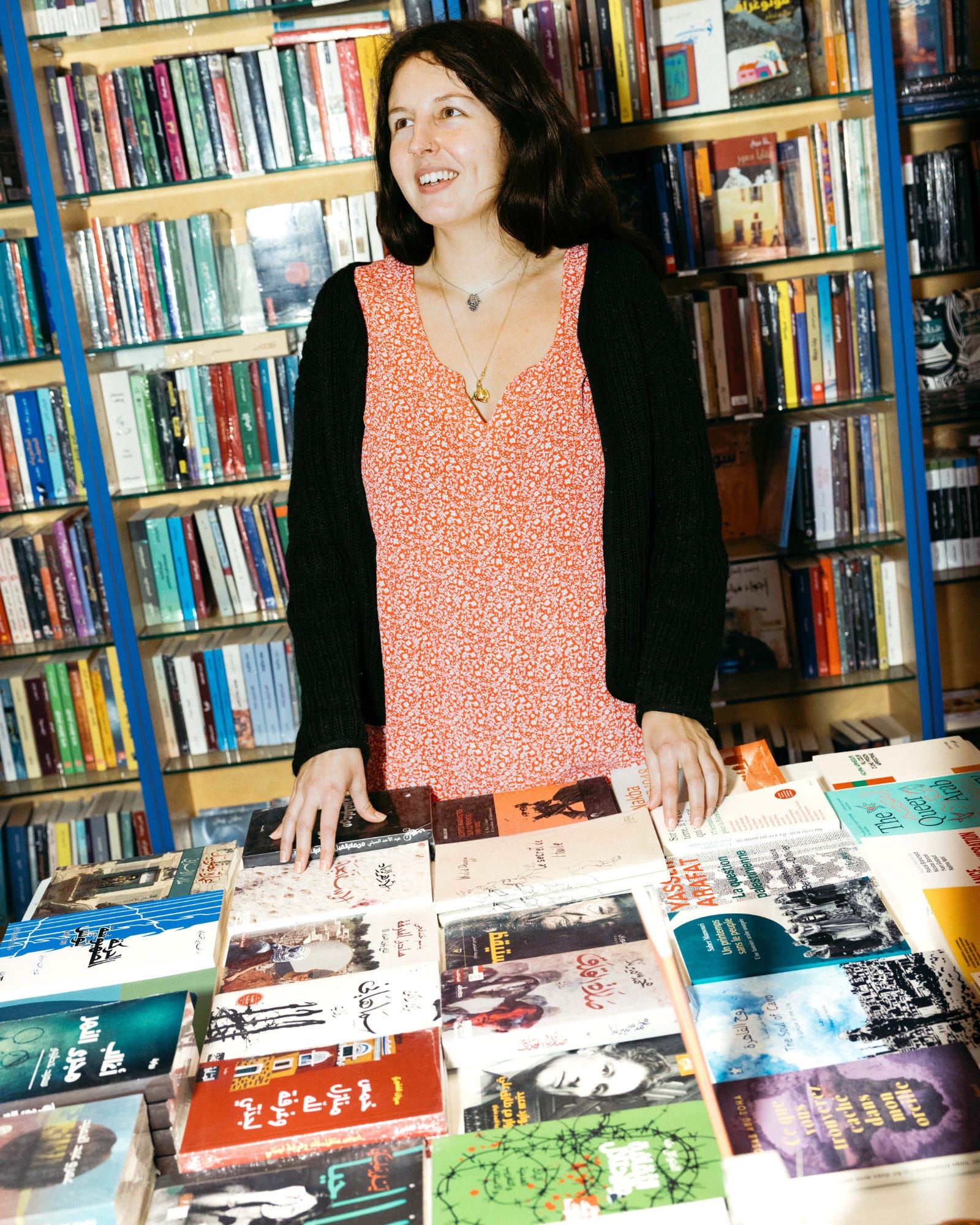
Code-switching with Caterina Detti
I first met Caterina Detti in early 2025 when I was researching a piece for the New York Times Travel section on the role of the Arabic language in Paris. I had recently started learning Arabic because I was intrigued by France’s second most-spoken language, with around 4 million speakers in the country. When a friend told me about Caterina’s bookshop, Maktaba Berfin, which sits on rue du Ruisseau just below Montmartre, I was eager to talk to her about it.
Caterina was born in Florence and grew up in Auckland speaking Italian and English. After studying history of art and film in New Zealand, she volunteered at a refugee camp in Greece, where she picked up her first few words of Arabic — the beginning of a long love affair with the language. When she eventually settled in Paris in 2019, she discovered how difficult it was to buy books in Arabic in Europe, and so she began sourcing them through friends of friends and carriers who brought them over from Sudan or Egypt. That venture led to the opening of one of Paris’s few Arabic-language bookshops in 2023 and today it draws readers from across Paris and beyond, with sought-after books sold through its website and Instagram account.
Though Caterina is still far from fluent in Arabic — a language with many dialects whose standard written form is rarely used in casual conversation — she continues to learn it while celebrating cultures from across the Arab world through regular poetry readings, live music events and a book club. In our conversation, we discussed her relationship to the four languages she uses in daily life, the problems with distribution in the Arab publishing world, and the place of Arabic in France. “People from the Maghreb who come in tell me they are rediscovering the beauty of Arabic, because they had stopped reading it — they only read in French,” she said when we met again recently. “There is a real reverence for the beauty of literary Arabic, and in particular its poetry.”
Paid subscribers can find Caterina’s list of essential works of Arabic literature at the bottom of the newsletter. Our conversation was lightly edited for length and clarity.
How many languages do you speak, and how did you learn each one?
I was raised bilingual in New Zealand, speaking English and Italian. I was born in Italy, so my first five years were bilingual, but I was more exposed to Italian. I learnt French as an adult in France, and I’ve been learning Arabic for a very long time, but I’ve reached a point where I’m progressing very slowly. The small amount that I know I use with my friends and at work.
When did you decide to learn Arabic?
I learnt Arabic while volunteering in a refugee camp in Sounio, south of Athens, where I learnt through immersion. Since then, I’ve never really managed to learn Arabic properly for various reasons — one being that I don’t have time to dedicate to lessons anymore. But even when I did, Arabic has regional dialects and country-based dialects, and then there’s Fusha, which is the standard Arabic that connects the Arab world. So if you’ve learnt through immersion — through meeting people or living in a certain country — when you leave that country or make friends from a different place, suddenly the Arabic that you picked up is of no or very little use, and it can be really frustrating.
You can choose to take lessons at a school and learn Fusha (Modern Standard Arabic) and that’s what you’re often encouraged to do because it allows you to travel across the Arab world and be understood. This is appealing, but you not only have to think about whether people will understand you, but also whether you will understand them. My friends are Lebanese and that’s the language I’m closest to, so I prefer to dedicate the little time that I have to learning to speak the dialect. Everyone who has ever studied Arabic has had to ask themselves these questions.
Which are your ‘mother tongue(s)’? Do you have any thoughts on the term ‘mother tongue’?
My mother tongues are English and Italian, but I am more at ease discussing more complex topics in English. I didn’t go to school or university in Italy. I think that’s quite common among children of immigrants. When it comes to the mother tongue, I think it can switch. Lots of children of immigrants know that you can grow up until you’re five or six speaking one language and then become more comfortable in another. You can even lose your mother tongue. Or perhaps you never lose it entirely, but you can become much more comfortable in the new language. A mother tongue, I think, is the language you are the most comfortable in, even if it’s the second one you’ve learnt.

What led to the idea of an Arabic language bookshop in Paris?
It started in 2016 when I wanted to buy books for Arabic-speaking friends. I went online to order a book, and quickly realised there wasn’t a lot of choice for Arabic-language books in Europe. There’s almost no choice for second-hand books either. There are very few Arabic-language bookshops in Europe: a handful in Germany, one in Italy… France has the Arab World Institute, but half of its catalogue is actually in French. So there’s a real lack of bookstores. Arabic speakers, especially from the Maghreb, who are able to go home multiple times a year, will come back with books in their suitcase because they can’t find them here, and when they do find them, they’re often three times the price. I thought not only is that sad for readers, but in a structural way, it’s really unfair. Arabic has been at the bottom of the hierarchy of languages, especially in France. People who have grown up with Arabic spoken at home here will tell you that Arabic wasn’t encouraged. So the idea that there’s this big gap of access to Arabic literature and Arabic language resources for adults and for children is problematic. My mother used to be a librarian, and in my family we believe in books and in reading — not just for the joys it brings, but because reading is important for society, for the individual, for children, for families. So I thought: opening a bookstore is a good thing.
What is your favourite word in Arabic?
My favourite word in Arabic at the moment is qalaq (قلق). I learnt it last year because the 2025 Arabic Booker winner was Salât al-Qalaq by the Egyptian writer Mohammad Samir Nada, which means “anxiety prayer”. When I found out that qalaq meant anxiety, I was like “of course it does”. It’s the letters qaf, lam, qaf, without any vowels in between. I thought, “yes, that word gives me anxiety just to look at it”.
